Follow me on Twitter

Showing posts with label ordinance xx. Show all posts

Sunday, May 4, 2014

My faith, My crime.

I remember clearly the moment when I realized for the first time that I was a criminal.

It was the autumn of 1993 in Rawalpindi, where I went to college. It was the living room of a friend of mine. We must have been having our usual contests of who can impress the other with the best trivia and unusual facts as teenager do, when my friend triumphantly stated

'If an Ahmadi says Azan (the Muslim call to prayers) he can be jailed for three years'.

I must have left a long gap between his trivia and whatever astonishing fact he expected me to return.

'Its in a book in my father's library'. He said. Obviously thinking that I didn't believe him. 'Its in the Pakistan Penal Code.'

I changed the subject. I must have thought of something to say. I can't remember much from that day, apart from a sense of anxiety that I usually felt in certain situations.

My friend did not know that I was an Ahmadi.

I told him about my faith a few months later. Surprisingly enough, he was OK with it. He was one of the rare few who remained my friends after knowing about my faith.


Such situations came way too often in my life. My family had to move from town to town due to my father's job. And each new move brought with it new classmates, new neighbours and new friends. All of whom would start wondering why I don't go to the nearest mosque for prayers. I suppose the grown-ups soon figured out the reason. It was however far too tricky for us children.

Most of my friend found out about my faith through gossip. I seldom had to volunteer the information and not many asked me directly. Being an Ahmadi in the post-Islamization Pakistan was dangerous. You could get beaten up or bullied in schools, by both the teachers and your classmates. I remember a classmate who would just casually walk up to me and punch me in the back saying that it was an act of 'sawab' (to be rewarded by God) to hit a 'kafir' (infidel). It was of course done as a crude joke, so I did my best to avoid him.

In another school, our science teacher would spend a whole hour explaining to us that Qadianis (Ahmadis) are kafirs. He knew fully well that there was a Qadiani 12 year old in his class. Fortunately, not many in my class knew that it was me. Funny thing is, that I liked that teacher because I like science and he was good at teaching it.

I knew that the dictator, General Zia had passed laws against us Ahmadis, and due to these laws, our 'Huzoor', the Khalifatul Masih had to leave Pakistan. We used to listen to his sermons through audio-tapes which were played at various prayer centers and Mosques that we used to attend for our Friday prayers.

But I was not aware of the real implications of these laws until I heard my friend pronounce the three year jail term for reciting the Azan.

I must have recited the call to prayers hundreds of times in my childhood. It is one of the first things we Ahmadis are taught as children. A Muslim must know the words as without the Azan, a congregation cannot offer any of their five daily prayers. I also learnt how to read the Quran, even memorizing some long passages. I offered my prayers in the manner no different to my Sunni friends. I went to the Ahmadiyya Mosque which looked no different than the Sunni Mosques. Our Imams read the same Arabic prayers before and after their sermons. We had two Eid celebrations, a month of fasting which started and finished with all the other Muslim sects.

But according to the Pakistan Penal Code, I was a criminal since April, 1984. I was a non-Muslim for the purposes of the Constitution by birth, thanks to Bhutto's 2nd amendment in 1974.

It would only require one police report to ensure I was thrown in Jail. At 17 years of age, I was a habitual criminal. I broke the Pakistani law on a daily basis. This realization dawned upon me on an autumn day while I was having a cup of tea in my friend's living room. This realization did not leave my mind for the next decade or so. I finally got free of its burden by leaving Pakistan.

You can understand that I was never a fan of General Zia, The architect of Afghan 'jihad' and the benefactor of the monstrosity that we now call the Taliban. He took it upon himself to rid the country of this 'cancer' of Qadianiyat which was a threat to both his version of Islam and his idea of Pakistan. The 2nd amendment to the Constitution of Pakistan had already paved the way for his ordinance XX. His aim was to decapitate the Ahmadiyya organization by going after the office of the Khalifatul Masih, the worldwide spiritual leader of the Ahmadi Muslims. The verbage used in the law was obviously aimed to target the Khalifatul Masih. His plans were foiled when Hazrat Khalifatul Masih IV, Mirza Tahir Ahmad left the country before a reason could be created for his arrest.

Zia died in a plane crash in 1988. But his laws survived the plane crash and the democracy which followed. No one dared touch any Islamic laws that Zia had enacted, including the notorious blasphemy and the Hudood laws. Even the liberal dictator, General Musharraf left these laws well alone. A dictator can suspend the constitution as many times as he likes, but its Islamic clauses remain valid at all times.


Some so-called liberal Pakistanis think that these laws have no real impact on the majority of the Ahmadis living in Pakistan. How wrong they are!


Since 1984, no new Mosques have been allowed to be built by the Ahmadis, hundreds of criminal cases brought against them for using the Islamic greetings or other Quranic texts in speech or in writing. Many more cases have been registered against Ahmadis for 'hurting the feelings' of the Muslims. Hundreds of Ahmadis have been murdered and their murderers walk free in most cases. These laws have made it impossible for Ahmadis to seek or even expect Justice in the courts of law.

In addition to this, Ahmadis are fair game for the notorious blasphemy laws too. An Ahmadi, just by being an Ahmadi is automatically guilty of blasphemy. How dare they believe in a prophet after the Last Prophet? How dare they believe in revelation after the Quran?

 Ordinance XX bars me from defending myself when such allegations were thrown at me. Any attempt to explain my beliefs were to be taken as proselytisation, which is a crime.

We cannot print books or sell and distribute them to non-Ahmadis. We cannot hold debates or seminars to share our ideas with others. We cannot print advertisements in newspapers or even expect them to print unbiased news regarding us. Even when we are massacred in our hundreds, the press struggles to report it as a human tragedy. But all care is taken to ensure that our mosques are not referred to as mosques in their reports.

Ahmadis have been relegated to a sub-human category of creatures in Pakistan.

I often think what will it take for Pakistanis to take a decisive step in correcting this grave injustice in their name? I think of all my non-Ahmadi friends I left behind in Pakistan and wonder what they thought about these laws really. Not many had the courage to condemn these laws. They thought that this was a religious matter and should never be discussed between good friends.

But this is not a religious matter at all. These laws were the menifestation of demagoguery of the clergy and arrogance of a ruthless dictator. If anything, these laws are an insult to the religion of Islam.


To help repeal these unjust laws, I urge you to sign this petition.

Thursday, November 21, 2013

1974: In response to Nadeem F. Paracha

Nadeem F. Paracha is a respected columnist of the left-wing variety, a rare species in Pakistan these days. He is a keen observer of the modern history of a nation in the process of self-combusting into oblivion. I understand and share his pain at this hopeless, prolonged and soul destroying state of affairs in Pakistan.


In his attempt to understand and explain the reasons behind Prime Minister Zulfiqar Ali Bhutto's 'compromise' over the Ahmadiyya issue in 1974, NFP has made a few factual errors. Errors which almost seem like an attempt to shift some blame for the 2nd constitutional amendment to its victims, the Ahmadi Muslims. NFP calls this a 'theological issue' and excuses himself from giving any opinions on its religious aspects. Ironically, at the same time he blames the myopia and laziness of the secular intelligentsia to blame Bhutto alone for this whole debacle. The matter of deciding on someone's faith is nothing but a theological issue.


It is laziness and myopia indeed if an opinion is given without considering the religious motives which caused it. NFP then gives an opinion which is rather theological in nature:


"The Qadianis claimed that Mirza was a prophet, and accused all Muslims who did not accept him as being non-Muslims"
.


The above opinion is based on the false allegations raised by the Anti-Ahmadiyya clergy which was thoroughly discussed and refuted during the In-Camera proceedings held in 1974. Why was this question even taken to the parliament? A parliament of a secularist, socialist majority should have known better!


Ahmadis DO NOT consider anyone who claims to be a Muslim to be Non-Muslim, even if they reject the claims of Hadhrat Mirza Ghulam Ahmad of Qadian as the Promised Messiah. In Ahmadiyya theology, this 'Kufr' or rejection of a Divinely appointed Imam (Mamur) is considered a sin, which makes the rejecter answerable in the eyes of God. It has to be understood that Ahmadiyya Muslims interpret the word 'Kufr' in a Quranic context and not as an absolute term of exclusion and hatred commonly used by the Mullahs against each other.


So my dear Nadeem F. Paracha, you have to understand the theology to understand the Ahmadiyya viewpoint. It is nothing but laziness and myopia if you don't even try.


Now to the events of 1974 which culminated in that constitutional amendment. I find it rather amusing that NFP would defend Islami Jamiat Tulaba (IJT) like this. Even if a bunch of hooligans shouting profanities at Rabwah railway station got away with 13 minor injuries (as Samdani commission report confirmed) as a result of a brawl, does that mean that the whole community should be punished for the actions of a few?


And where did you get the idea that some 'Ahmadiyya leaders' were involved in planning a violent response. Ahmadiyya Jamaat's leaders do not resort to violence. Our 130 years history is a witness to that. The fact is, that some Ahmadiyya youths were involved in this brawl which took place on 29th of May because the IJT students, while shouting abuse from the outbound train a week before had also threatened violence on their way back on the 29th. The head of the Ahmadiyya Muslim Community, Hadhrat Mirza Nasir Ahmad had condemned the actions of those misguided Ahmadis in his Friday sermon on 31st of May.


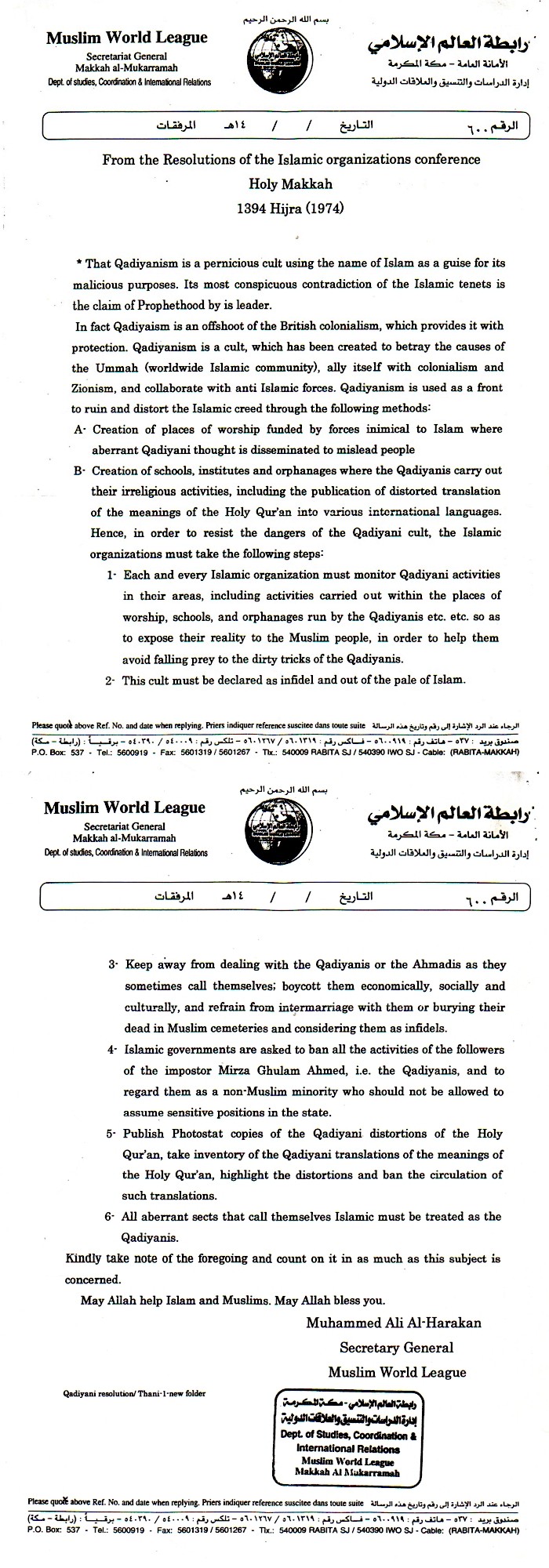
I also believe that the Rabwah Railway incident was a pre-planned event, used as a pretext to start a violent street agitation against the Ahmadiyya Jamaat. A year before this incident, in spring 1973, an extraordinary session of Ahmadiyya Jamaat's Majlise Shoora was called in which the Khalifatul Masih (Mirza Nasir Ahmad) had informed delegates from all over Pakistan that a grand conspriacy was being hatched against the Jamaat. He had even outlined the methods likely to be used including using hypocritics within the community. Rabwah railway station incident was not a random event. On the day of the brawl, Faisalabad Mullah rags had published fictitious accounts of mutilations of the innocent 'Muslim youths' at the hands of Qadiani 'goons'. JI leadership was in cahoots with the Petro-Dollar funded Rabita Alam e Islami who had issued an edict to boycott Ahmadis and remove them from key posts only a year ago. It is no surprise that the student wing of the same organization then gets the ball rolling at Rabwah.


Agha Shorish Kashmiri was fawning over King Faisal at the OIC conference and praying for his speedy ascendency to the office of Khalifa for all Muslims. Mr. Bhutto was not blind to the immense wealth and prestige which came with the Saudi patronage. It only made sense for a person of his ambition to sacrifice the Ahmadiyya Muslims to gain popularity among the religious minded masses of Pakistan. Maulana Kausar Niazi wrote in his book “The last days of premier Bhutto”;


"He was referring to the Constitutional Amendment regarding the Ahmadis, which has prompted country wide celebrations. Mr. Bhutto felt that the credit which should have gone to his government had not been accorded. “The maulvis are claiming all credit for the Amendment,” he complained, “we must portray the true picture before the people."


Here is another interesting observation. PPP of early days was branded a communist party by the religious right. With such a toxic label, Mr Bhutto had no hope to win many seats in Punjab in 1971 elections. It was Mirza Tahir Ahmad, who later became the 4th head of the Ahmadiyya Muslim Community who helped PPP leadership to choose the appropriate candidates in Punjab which then ensured a very unlikely PPP victory. Ahmadis were helping the country to follow more progressive path and they supported the only party which was serious in its secular and enlightened vision for the country’s future.


Bhutto then stabbed his benefactors in the back, and while in his jail cell five years later, equated the Ahmadiyya Muslim community to the 'Jewish Lobby' in USA. He had tears in his eyes when he had to insist that he was a Muslim because a high court judge had called him a 'Muslim in name only' during his murder trial.


He died believing that maybe his act of declaring Ahmadis Non-Muslims will become the cause of his forgiveness.


Whether he will be forgiven or not, God is the only Judge of that. But Mr. Bhutto left the country firmly in hands of religious bigots for a long time to come. Even people like Nadeem F. Paracha cannot bring themselves to accept that their beloved leader sacrificed the soul of Pakistan 40 years ago.


How can we hope for things to change?
Here is the Ahmadiyya response to the declassified In-Camera proceedings and the historic background to the 2nd amendment.

Tuesday, September 11, 2012

#JalsaUK


The 46th annual convention of the Ahmadiyya Muslim Community, UK took place between 7-9 of September, 2012. It happens every summer. Every year, for three days around 30,000 delegates converge in a large Hampshire farm, called Hadeeqat-ul-Mahdi. These delegates comprised of more than 80 nationalities this year, but the largest contingent to this Jalsa comes from Pakistan. Majority of British Ahmadis are also of Pakistani origin most of whom have immigrated not for economic reasons, but to escape persecution in Pakistan.


46th Jalsa Salana UK, which is held near Alton, Hampshire.

Around 30,000 men, women and children from 88 different countries were in attendance this year
This year's Jalsa Salana went as planned. There were speeches from scholars, messages from the PM and the leader of the opposition, a couple of MPs also addressed the gathering. But people come to the Jalsa to listen to something much more important than any of these speakers. They make the journey to be in the presence of their spiritual guide, the Khalifatul Masih V, Hadhrat Mirza Masroor Ahmad. When he arrives at the main Marquee the whole place erupts for a few minutes in slogans from his devoted followers. When he takes his seat, the whole crowd falls silent, eagerly waiting for him to speak. Their attention never wanes, their sights fixed at the stage in devotion and respect. 'They love their Khalifa' is an observation often heard by external visitors to the Jalsa.

Hadhrat Mirza Masroor Ahmad, Khalifatul Masih V

This year saw another expression of this love. Every time the Khalifatul Masih started to speak, #JalsaUK started to trend on Twitter in Pakistan. For the first two days, it trended for a few hours. Also followed by Germany and Canada. On the third day, #JalsaUK was trending in Pakistan for the whole afternoon. And it stayed at number 2 spot for almost the whole evening. Scrolling through the messages you could read the desperate longing in the messages. A longing to be at the Jalsa Salana; a sense of loss and helplessness. Something that Pakistani Ahmadis have felt constantly after the promulgation of draconian Ordinance XX in 1984 by General Zia, which forced the Khalifatul Masih IV to leave the country. In 1983, close to 250,000 had attended the Jalsa Salana at Rabwah. No Jalsa Salana has been held there since then. It has been banned under the law in addition to many other basic human rights for Ahmadis. 

The generation of Ahmadis tweeting their messages at this Jalsa has not seen a Jalsa Salana. They have only heard of its stories through their parents and elders. When they see their Khalifa meeting their fellow Ahmadis in Africa, North America and Europe in their annual conventions, the feeling of being persecuted multiplies manifolds.


#JalsaUK trending at #7 in Pakistan, 9-Sep-2012. It went upto #2 spot later.


It is important to understand that for Ahmadis, their lives revolve around the institution of Khilafat. The spiritual leadership which has continued after the demise of Hadhrat Mirza Ghulam Ahmad, the founder of the community. Khilafat is nothing new in Islam. Every Muslim knows how important it is for their guidance and unity of the'Ummah'. But that Khilafat was lost long time ago, and ever since all Muslims await the day when Mahdi or Messiah will come to re-establish it. Some are even trying now to elect a Khalifa who can be a central religious and political authority for Muslims all around the world. But for Ahmadis, their Khilafat is already here, because Mahdi and Messiah has already come.


A view of Jalsa Salana in Rabwah, 1983. More than 250,000 people attended.
This twitter trend which was seen on Jalsa days was just another sign of how deeply Ahmadis of Pakistan are attached to the institution of Khilafat. Ahmadis do not partake in street protests or violence and effigy burning to  vent their frustrations. But #JalsaUK was perhaps also a protest of sorts. A protest to remind the 2 million twitter users of Pakistan that a UK based event of little public interest should not be trending in their country. It should have been #JalsaRabwah, where people from all over the world flocked before 1984. Trains and buses laden with the faithful arrived in Rabwah in late December to enjoy the hospitality of its residents. For them, it was a sign of hope for Pakistan which had just suffered yet another coup and its society was to change for the worst.

Banning the Jalsa in Pakistan and making the lives of Ahmadis unbearable is considered as achievement by many in Pakistan.Something that even the ex-Prime Minister celebrated this year. But when the educated, social media savy Pakistanis saw #JalsaUK trend in Pakistan, they did not even bother to take any notice or find its cause. Could it be that one Rao Abdul Ghaffar, an Ahmadi teacher was killed in Karachi, or another Ahmadi gravely wounded in Sindh? Or was it the defacing of many graves in Punjab during the same week? Was it because their mosques are being modified and whitewashed to make sure they do not look like mosques anymore?

When it comes to individual events of brutality and persecution like above, some individual liberals will raise their voice and condemn it. But when it comes to a collective expression of feelings like this, all these liberals kept silent. A couple of them when goaded by Ahmadis on twitter were callous enough to respond negatively. Callousness and lack of respect could explain such behaviour, but more importantly its a lesson for young Ahmadis in Pakistan. No one in Pakistan wants to know how it actually feels to be an Ahmadi in such a country. A country ravaged by religious bigotry, brought to its knees by the same people who persecute Ahmadis, but still a country which fails to feel your pain.

And unless they feel your pain, they will not undo the injustice that has been done to you.

Topics

ahmadiyya (44) islam (35) pakistan (29) qadiani (27) muhammad (8) Quran (7) muslim (7) taliban (7) Imam Mahdi (5) Mirza Ghulam Ahmad (5) jesus (5) Messiah (4) in the shadow of the sword (4) india (4) jihad (4) EDL (3) ahrar (3) atheism (3) Mecca (2) Moses (2) bbc (2) bnp (2) lahore (2) maulvi (2) ahmadi (1) apostacy (1) bible (1)