If you profess to be a Muslim, you are required to pray five times a day. An adult male must attend the mosque to pray in congregation as many times as he can. That is why you can hear muezzins call to prayer, the Adhan, in all towns and cities around the Islamic world. Five times a day, the muezzin invites the faithful to his mosque to fulfill their duty towards their God.
A Mosque is like a second home to a Muslim; his first if he achieves the spiritual devotion as intended by the scriptures.
Now imagine a town where the local residents have tried to block the building of a Mosque for a tiny community. Imagine how hard it is to be a practicing Muslim having no access to a mosque. The townsfolk have a serious reason for their rejection of this mosque. They think that it would be a serious threat to their way of life. Not only that, they feel that any such construction would be against the religious tradition of the town and the country. Mobs attacked the under construction mosque numerous times despite repeated attempts by the community to seek police protection.
The community dropped the plans to build their mosque for the sake of maintaining peace in their small town and instead agreed with the local administration to build a residence in its place. They had an Imam to accommodate and living quarters of the mosque would have been ideal. Mosque or no mosque, the Imam was there to stay to cater for their spiritual and educational needs. But the locals weren't content with this arrangement. They wanted a guarantee that no prayer congregation could take place in that house.
You will be shocked to learn that a sworn affidavit to this effect was also duly signed by this community.
This all happened more than ten years ago. Now the community has received various threats from their neighbours to stop using the facility for prayers. They suspect that the Imam may be leading some of his visitors and guests in prayers in secret. The local police has been reminded of the affidavit and requested to take immediate action against the clandestine activities of this group.
It could easily have been a story of Christian, Mongol, Hindu or Sikh oppression of their Muslim subjects in the past.
But this story is about Pakistan: A Muslim majority country where these particular Muslims are not Muslim. Their mosque is not Mosque. In this town of Tatlay Aali, near Gujranwala, like the rest of the country since 1974, Ahmadis are a non-Muslim minority. Since 1984 they have no rights to build a mosque or call it one. Now we have learnt that according to the pious and right-minded residents of TatlayAali, they can't even pray within the confines of their homes as it is considered to be against the law of the land.
I heard this story from an acquaintance and had it verified. For me it came as no surprise as I have seen it happen numerous times before. Back in the early 90s, I witnessed the destruction of the under-construction mosque (or Qadiani temple as described by the press) in Rawalpindi. Local mullahs petitioned against the mosque in the courts and as a result, many thousands of Ahmadis in Rawalpindi are still without a mosque of their own.
Tatlay Aali is a typical small town in Punjab. It probably could still be classed as a village, but increasing urbanization in the region has blurred the line between a village and a small town even more. It probably used to have a diverse population. A beautiful Sikh Gurudawara still stands tall, although deteriorating due to lack of use and maintenance.
I don't need to explain why the Sikhs left. A small Christian community also lives here.
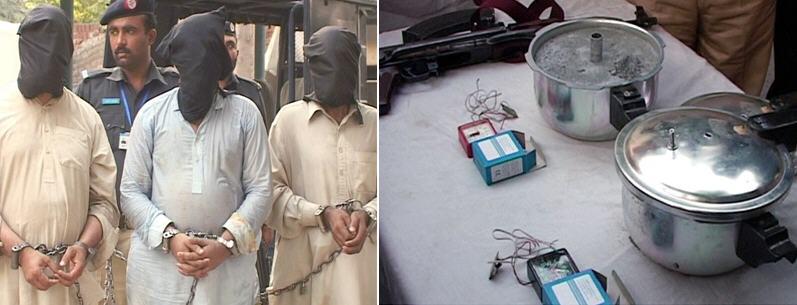
Like the rest of the country, terrorism and religious extremism are threatening the very core of this society too. In Tatlay Aali, you hear the news of armed militants seeking safe houses in the local madrassah and engaging the local police in a shootout. A seminary teacher also got arrested for training small children for terror activities.
Tatlay Aali: Four terrorists with their pressure cooker bombs. Image courtesy express.com.pk
The town isn't doing so well on the moral front either.
While the local seminary provides shelter to terrorists, crime against donkeys makes headlines. Four poor donkeys were abducted by thieves and their skinless carcasses were discovered in the fields. I am puzzled myself, but in a country where donkey meat has been served in many a restaurants as mutton, donkey hide must have its uses.
Another news item described a case of incest - rather the rape of a girl by her father. Also in the news are numerous stories of murder and abductions.
Human rights commission of Pakistan reported in 2008 two harrowing incidents in Tatlay Aali . One, of a labourer whose fingers were chopped off by a landlord for refusing to do his bidding, and of a family of seven sold in slavery to another landlord for just over 1400 US dollars.
A young man commits suicide after having an argument with his older sister. Whereas the local police arrested a number of gentlemen on drug and alcohol related offenses. Police also discovered a brothel and arrested few people.
Organizations of various Sunni or Wahabi affiliations are aplenty in this part of the world.
One news site lists all the happening news in the region and almost the whole page is full of statements from religious leaders of this town decrying the threat of secularism to the country. One Jamaat-e-Islami leader told a rally that one should never compromise on the belief of Khatme nabuwwat, the finality of prophethood.
A leader of Sunni Tehreek laments the fact that crimes of corruption, nepotism and armed robberies are rife in the area, sewers and garbage dumps are overflowing on their streets and people are suffering under the current government.
Despite a couple of seminaries, dozens of constitutionally acceptable Mosques and tens of religious organizations, the very small Pakistani town of Tatlay Aali seems to be festering in all sorts of depravity and moral ills.
Should I be surprised that the congregational prayers of a small group of Ahmadis are a threat to the town's religious way of life?
The first ever person to be known as Mahdi was called Muhammad ibn al-Hanafiyyah son of Ali ibn Abi Talib, the fourth Caliph. After the tragic events of Karbala, there was no one the Muslim masses could see as their spiritual leader. Imam Hussain’s only surviving son was too young at that time. As is the case with all political intrigues, a gap needed to be filled by opportunists. Muhammad ibn Ali was proclaimed the rightful heir to the Prophet. He was called the Mahdi, the Promised Guided Leader as was foretold by the Holy Prophet himself.
This did not last for long. Muhammad ibn Ali vanished from Madina one day. A famous poet of his time wrote a eulogy, calling him to return and take his rightful place as the leader of Muslims. The story of a hidden Imam in a cave began from this Mahdi, the first one but not the most famous one.
Since then, the title of Mahdi has been used by many people in the hope to gain popular support. Revolutionaries used it to overthrow the incumbent Caliphs. Caliphs used it to cement their authority. Various religious sects used it to attract converts into their cults. But none of these so-called Mahdis ever fulfilled the propehcised purpose of his advent.
Then there was the boy-Mahdi who also vanished into a cave. Shia Muslims await for his triumphant reappearance even to this day.
The Boy Mahdi. Muhammad ibn Hasan al-Mahdī
Shah Waliullah was a scholar and Sufi who witnessed the post-Aurangzeb decline of the Mughal empire.
He was known as the Muhaddath of Delhi. A great scholar of Quran and Hadith as well as a Saint. And in his case, he also claimed that God spoke to him.
He could not bear to see political and moral decline of his people. It is said that he received visions and revelations about the imminent arrival of the Mahdi. One of these revelations even said that if Waliullah was to affect a revolution, he may well be the Mahdi himself. But he was not very comfortable with this idea.
He knew that Mahdi is supposed to appear in Arabia, fulfilling many prophecies mentioned in Hadith. We don't know if it was the ernest desire of Shah Waliullah to find the rightful Mahdi or failing that, be that Mahdi himself: He left Delhi for Hejaz. He would remain in Makkah and Madina for almost a decade.
Shah Waliullah was certain of the coming of the Mahdi whose arrival would begin a new era of glory for Islam. His estimates placed the Mahdi during his time, as a famous Hadith had foretold that the signs for Mahdi would start appearing after one thousand years. But no Mahdi appeared in his life time. Shah Waliullah wrote that he received instructions in various visiions to go back to India and continue his religious leadership for the Indian Muslims. He died in 1762.
The beginning of 19th century saw a failed claimant of Mahdi in India. It was before the British had taken full control over the subcontinent. A man calling himself Ahmad and Rajah Nukluk sent a letter to the English governor or Surat to accept him as the Imam. The governor sent his army as the response, and he was killed along with a handful of his followers.
Syed Ahmad of Bareli, the famous freedom fighter and a follower of Shah Waliullah was also hailed as the Mahdi by some of his followers. But he also vanished mysteriously after the Battle of Balakot in 1831, never to be seen again.
Muhammad Ahmad of Sudan, a famous scholar of the Qadri order of Sufis arose as the next Mahdi. He claimed to have received revelations and visions confirming him to the status of the promised Imam. He rose against the Turkish as well as the British Colonial rulers. Inflicting defeat after defeat to his adversaries, he finally succumbed to the British onslaught. Muhammad Ahmad had all the hallmarks for a successful revolutionary. Like Shah Waliullah, he was educated and pious. He had a fanatical following and influence over a vast territory. Even the Sharif’s of Makkah feared him.
In order to fulfil the prophecies regarding the Mahdi to the letter, Muhammad Ahmad even planned to go to the Hajj in 1882 to claim his leadership over all Muslims. He either abstained from going through with his plan or was prevented from it due to his military campaigns.
Hadhrat Mirza Ghulam Ahamd of Qadian India, also claimed to be the Mahdi. He founded the Ahmadiyya Movement in 1889. He did not have a political agenda or a military solution for the Muslims. His defense of Islam against he onslaught of Christian and Arya missions stood the test of time. Even the sun and the moon eclipsed in his time in a particular order as foretold in a famous Hadith. If there was ever a Mahdi prophecised, and I believe there was, it was bound to be someone who fulfilled the prophetic words not only in his person, but also in deeds. Most importantly for an outside observer it is the outcome of his deeds which have started a revolution.
One of his followers and companions was Abdul Latif of Afghanistan. A high ranking official of the court of Kabul and a well known scholar of his time. He once told that before he had known about the claims of Hadhrat Ahmad, he had received so many revelations from God about the immediate appearance of Imam Madhi that he feared that it could even be him. Like Shah Waliullah, he also knew the significance of these revelations. So he also started his Journey to Arabia for Hajj, only to discover that a Mahdi has appeared in Qadian. Abdul Latif never went to Hajj, instead he pledged his life to the Mahdi. Soon after his return to Afghanistan, Abdul Latif was charged with apostasy and stoned to death in Kabul.
Success is the best proof of Divine support. Where all the other claimants of Mahdi failed, Hadhrat Ahmad's success despite intense persecution and opposition around the world shows that he was true in his claims. All those prophecies about the guided one were true all along.
Luton's 'Preservation of the Finality of Prophethood Forum' has finally published a rebuttal to the Ahmadiyya Muslim advert which had reportedly offended the Muslims of Luton. This is a paid advert published in this week's Luton on Sunday.
And the point is?
I was pleased to see that the writers of the advertisement have used civil language which is a remarkable achievement by itself. I am sure that the hate speech laws would have caused many edits before the piece was sent to the printers.
I say this because in my experience, all 'Khatme Nabuwwat' (Finality of Prophethood) organizations are known for their venomous language against the Ahmadiyya Muslims. This language often breeds violence against the community, the most recent example of which was in Hyderabad, India, where a drunken mob attacked the Ahmadiyya Mosque during the Friday prayers.
It is refreshing to see that Luton's anti-Ahmadiyya Mullahs are willing to share their beliefs with the community without inciting violence and hatred.
How does their definition of a Muslim help any of the readers is another matter.
When did the finality of prophethood become one of the central tenets if Islamic beliefs?
The committee of 22 Mosques in Luton would struggle to find a verse in Quran to justify this belief. They do present a verse in the advert
' Muhammad is not the father of [any] one of your men, but [he is] the Messenger of Allah and last of the prophets.' (33:40)
The term used here is 'Khataman Nabiyyeen', translated by the classical translators like Pickthal, Yusuf Ali and Arberry as the Seal of Prophets. This term has been understood by the commentators to mean the best of the prophets. But since the founder of the Ahamdiyya Muslim Community claimed to be a subservient prophet to Muhammad (peace be upon him), his opponents have rejected the more sublime understanding of the verse in favour of a pedestrian one.
Before the inception of Ahmadiyya Islam, classical Islamic scholars had no doubt about the coming of a prophet within Muslims who would reform them and teach them the true wisdom of the Quran. He has been referred to in the Hadith as 'Eesa Ibn Maryam', Jesus, Son of Mary. Muslims have been, and most are still waiting for the Promised Messiah.
Herein lies the great dilema for our friends at the Finality Forum. How can they declare an end to the institution of Prophethood when their own advert claims that 'Lord Almighty in His Grace, never left mankind without any religious guidance'?
What they don't share with their readers is the unanimous belief of all the 22 Luton mosques, and the Muslims around the world that Jesus will descend from the heavens and he will be a prophet for the Muslims. A hadith in Tabarani, quotes the Holy Prophet (Peace be upon him)
'And remember, there is no prophet between me and him (the Promised Messiah)'
There are many other prophetic sayings (Ahadith) which refer to the Promised Messiah as a prophet.
There is no difference of opinion between the Ahmadi Muslims and the rest about the absolute supremacy of the Quranic message until the end of days. i.e., Holy Prophet Muhammad (peace be upon him) is the Seal of Prophets. His era continues until the day of judgement. The hadith quoted in the advert 'there will be no prophet after me' only refers to a new prophet bringing a new book or a new law.
But what becomes of the Muslims when they lose their way? When some of them start using their distorted understanding of the Quran to usrup the rights of mankind? When the quest of scientific knowledge is deemed sinful and difference of opinion is met with fatwas of heresy? Don't they need reform? And a prophet is, as the advert points out ' a reformer and an orthodox humanitarian'.
Whether or not you accept Mirza Ghulam Ahmad's claim to be a prophet is not relevant here. The fact that you need to contradict yourselves to counter his claims reveals the stubbornness so symptomatic of a people in dire need of reform.
Luton's 22 mosques belong primarily to the Barelvi (sufi) sect. Ibne Arabi, the great Sufi mystic, known as the Seal (Khatam) of Mystics by many, saw the coming of a prophet in Islam as an absolute necessity. He awaited the second coming of Jesus in a 'new body' who will follow the law of Quran.
But Ibne Arabi is considered a bit of a heretic himself by the more puritanical Wahabi Muslims. A great Indian scholar, Shah Waliullah of Delhi, highly regarded by the non-barelvi sects as an authority in Quran and Hadith states that only prophethood with a new law has come to an end. He also wrote that the Promised Messiah will be a true image of Muhammad himself.
For any Deobandi Mosques in Luton, I present the definitive statement of Qasim Nanotawi, the founder of Deoband sect in India, who said that the coming of a new prophet after the Holy Prophet does not break the 'Seal'. This has been a hotly debated issue between the Barelvi and Deobandi sects, each blaming the other for agreeing with the 'Qadianis'.
How unorthodox of the orthodoxy. A newfangled definition of a Muslim? That is the last thing one expects from them.
Despite the contradictions I have pointed out above, the advert is a step in the right direction.
By promoting their own cause and desisting from hate speech, the forum has taken a leaf out of the Ahmadiyya book. I urge them not to stop here. Please copy the whole book. Lets start by being more inclusive and less dogmatic. Lets remove any notions of a separatist, ghettoised interpretation of Islam from our minds and show more loyalty and commitment to the country we call our home. And above all, let us share the humanitarian, tolerant message of the Quran in our towns and cities.
Nadeem F. Paracha is a respected columnist of the left-wing variety, a rare species in Pakistan these days. He is a keen observer of the modern history of a nation in the process of self-combusting into oblivion. I understand and share his pain at this hopeless, prolonged and soul destroying state of affairs in Pakistan.
In his attempt to understand and explain the reasons behind Prime Minister Zulfiqar Ali Bhutto's 'compromise' over the Ahmadiyya issue in 1974, NFP has made a few factual errors. Errors which almost seem like an attempt to shift some blame for the 2nd constitutional amendment to its victims, the Ahmadi Muslims. NFP calls this a 'theological issue' and excuses himself from giving any opinions on its religious aspects. Ironically, at the same time he blames the myopia and laziness of the secular intelligentsia to blame Bhutto alone for this whole debacle. The matter of deciding on someone's faith is nothing but a theological issue. It is laziness and myopia indeed if an opinion is given without considering the religious motives which caused it. NFP then gives an opinion which is rather theological in nature:
"The Qadianis claimed that Mirza was a prophet, and accused all Muslims who did not accept him as being non-Muslims"
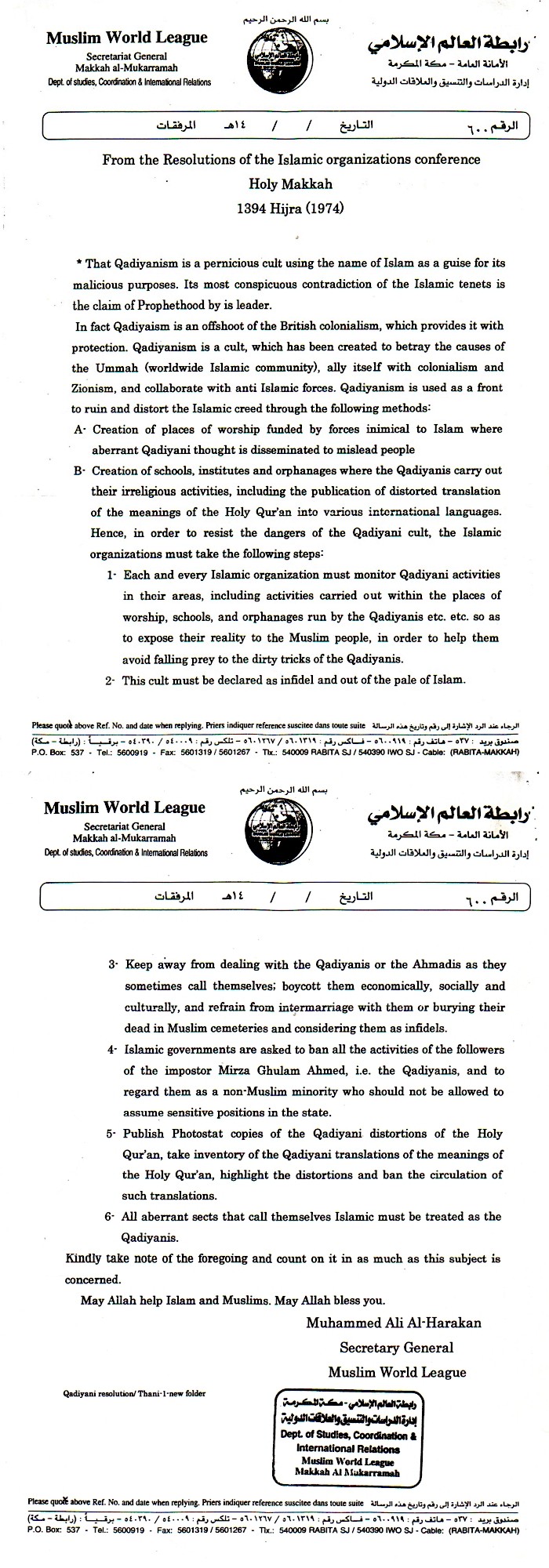
. The above opinion is based on the false allegations raised by the Anti-Ahmadiyya clergy which was thoroughly discussed and refuted during the In-Camera proceedings held in 1974. Why was this question even taken to the parliament? A parliament of a secularist, socialist majority should have known better! Ahmadis DO NOT consider anyone who claims to be a Muslim to be Non-Muslim, even if they reject the claims of Hadhrat Mirza Ghulam Ahmad of Qadian as the Promised Messiah. In Ahmadiyya theology, this 'Kufr' or rejection of a Divinely appointed Imam (Mamur) is considered a sin, which makes the rejecter answerable in the eyes of God. It has to be understood that Ahmadiyya Muslims interpret the word 'Kufr' in a Quranic context and not as an absolute term of exclusion and hatred commonly used by the Mullahs against each other. So my dear Nadeem F. Paracha, you have to understand the theology to understand the Ahmadiyya viewpoint. It is nothing but laziness and myopia if you don't even try. Now to the events of 1974 which culminated in that constitutional amendment. I find it rather amusing that NFP would defend Islami Jamiat Tulaba (IJT) like this. Even if a bunch of hooligans shouting profanities at Rabwah railway station got away with 13 minor injuries (as Samdani commission report confirmed) as a result of a brawl, does that mean that the whole community should be punished for the actions of a few? And where did you get the idea that some 'Ahmadiyya leaders' were involved in planning a violent response. Ahmadiyya Jamaat's leaders do not resort to violence. Our 130 years history is a witness to that. The fact is, that some Ahmadiyya youths were involved in this brawl which took place on 29th of May because the IJT students, while shouting abuse from the outbound train a week before had also threatened violence on their way back on the 29th. The head of the Ahmadiyya Muslim Community, Hadhrat Mirza Nasir Ahmad had condemned the actions of those misguided Ahmadis in his Friday sermon on 31st of May. I also believe that the Rabwah Railway incident was a pre-planned event, used as a pretext to start a violent street agitation against the Ahmadiyya Jamaat. A year before this incident, in spring 1973, an extraordinary session of Ahmadiyya Jamaat's Majlise Shoora was called in which the Khalifatul Masih (Mirza Nasir Ahmad) had informed delegates from all over Pakistan that a grand conspriacy was being hatched against the Jamaat. He had even outlined the methods likely to be used including using hypocritics within the community. Rabwah railway station incident was not a random event. On the day of the brawl, Faisalabad Mullah rags had published fictitious accounts of mutilations of the innocent 'Muslim youths' at the hands of Qadiani 'goons'. JI leadership was in cahoots with the Petro-Dollar funded Rabita Alam e Islami who had issued an edict to boycott Ahmadis and remove them from key posts only a year ago. It is no surprise that the student wing of the same organization then gets the ball rolling at Rabwah. Agha Shorish Kashmiri was fawning over King Faisal at the OIC conference and praying for his speedy ascendency to the office of Khalifa for all Muslims. Mr. Bhutto was not blind to the immense wealth and prestige which came with the Saudi patronage. It only made sense for a person of his ambition to sacrifice the Ahmadiyya Muslims to gain popularity among the religious minded masses of Pakistan. Maulana Kausar Niazi wrote in his book “The last days of premier Bhutto”; "He was referring to the Constitutional Amendment regarding the Ahmadis, which has prompted country wide celebrations. Mr. Bhutto felt that the credit which should have gone to his government had not been accorded. “The maulvis are claiming all credit for the Amendment,” he complained, “we must portray the true picture before the people." Here is another interesting observation. PPP of early days was branded a communist party by the religious right. With such a toxic label, Mr Bhutto had no hope to win many seats in Punjab in 1971 elections. It was Mirza Tahir Ahmad, who later became the 4th head of the Ahmadiyya Muslim Community who helped PPP leadership to choose the appropriate candidates in Punjab which then ensured a very unlikely PPP victory. Ahmadis were helping the country to follow more progressive path and they supported the only party which was serious in its secular and enlightened vision for the country’s future. Bhutto then stabbed his benefactors in the back, and while in his jail cell five years later, equated the Ahmadiyya Muslim community to the 'Jewish Lobby' in USA. He had tears in his eyes when he had to insist that he was a Muslim because a high court judge had called him a 'Muslim in name only' during his murder trial. He died believing that maybe his act of declaring Ahmadis Non-Muslims will become the cause of his forgiveness. Whether he will be forgiven or not, God is the only Judge of that. But Mr. Bhutto left the country firmly in hands of religious bigots for a long time to come. Even people like Nadeem F. Paracha cannot bring themselves to accept that their beloved leader sacrificed the soul of Pakistan 40 years ago. How can we hope for things to change?
Here is the Ahmadiyya response to the declassified In-Camera proceedings and the historic background to the 2nd amendment.
A popular slogan of Takfiris. 'Shia are Kafir-whoever disgarees with it is also a Kafir'.
Yahya Bakhtiyar, Mufti Mahmood and many others maintained that the Ahmadis were declared Non-Muslims because their Khalifa accepted in the Parliament that they consider all others Muslims as Kafir.
Mr. Bakhtiyar confirmed this in an interview with Aatish Fishan, Lahore in their May 1994 publication. He thought that during the cross-examination, Mirza Nasir Ahmad was forced to accept that Non-Ahmadis cannot be true Muslims.
A famous Barelvi Fatwa against M. A. Jinnah. The founder of Pakistan.
This matter was settled by a comprehensive response in the Mahzarnama by the Khalifatul Mashi III, which not only quoted fatwas (edicts) of heresy, apostasy and worst by all major sects of Islam against each other, but also gave a detailed description of the Ahmadiyya opinion on Kufr , Eeman and Islam.
It all boils down to..
The Ahmadiyya point of view on this matter can be summed up by two phrases used by Imam Raghib in his Mufridaat.
Doon-ul-Eeman: Those Muslims who are at a lower standard of faith; i.e., they are Muslims because they profess to be Muslims.
Fawq-ul-Eeman: Those Muslims who are at a distinguished standard of faith. i.e., they try to fulfill all of the criteria set in the Quran to attain spiritual distinction in the eyes of God.
During the cross-examination, the Attorney General kept discussing the labels of Kufr and Islam as a corporation would use it for copyrights purposes. Something that all the Mullahs present in the house could easily relate to. But the fact is, that Quran does not treat the subject of faith as a copyright issue.
Kufr (denial) has many degrees. A person can commit kufr though their actions while still professing to be a Muslim. For example, someone who does not offer his daily prayers becomes a Kafir. Sahih Muslim, the second most authentic book of Hadith has a chapter on this topic. But does this mean that all those who miss a single prayer in their life become Non-Muslims?
Imam Ibn-e-Taimiyyah, a famous Jurist who is held in high esteem by the more orthodox Sunni sects, also held the same belief. The following statement from his book was quoted by the Khalifatul Masih III in his statement.
"One type of Kufr causes the person to be removed from the Millat (Nation/Ummah) whereas the other type of Kufr does not." (Kitab-ul-Eeman, page 171).
Fawq-ul-Eeman and a Joke:
While discussing the 'True Islam' or the faith which entitles someone to be on Fawq-ul-Eeman, Khalifatul Masih III read a quote from the book of the founder of the community (page 820). This quote outlines the view of Hadhrat Ahmad on what he considered to be the pristine form of faith. Yahya Bakhtiya responded with a joke about a simpleton who responds to a Mullah's description of the razor thin bridge leading to the gardens of paradise;
'Why don't you say I can't go to paradise, Maulvi sahib'. Asked the poor soul.
The proceedings do not record if the house was amused by the joke. But one member did not like the passage being quoted and objected by saying that its just an effort to show how pious the Ahmadis are.
But it becomes abundantly clear from reading the Ahmadiyya responses, that Ahmadis consider all those who delcare and consider themselves to be Muslims as Muslims.
Another fake reference:
The questioning committee comprised of representatives from all religious parties. One of their tasks was to support their questions with appropriate references and quotes. The Attorney General appears to be caught short at numerous occasions where a carefully crafted question was sabotaged themselves by a bogus reference. Mr. Bakhtiyar read a sentence from a speech delivered by Hadhrat Khalifatul Masih II in conference in London.
"Ahmadis to form a separate community from outside (the) Musalman(s)." (page 843)
This sentence does not exist in the speech.
Yahya Bakhtiyar's confusion:
What the Attorney General understood as his triumph was actually an indication of his poor grasp of the matters of faith and spirituality. In his concluding remarks he said
'According to Mirza Nasir Ahmad, he (anyone who does not accept the prophethood of Mirza Ghulam Ahmad) remains within the Millat-e-Muhmmadia, but he is ouside the Dairah or circle of Islam. This was all lost to me.' (page 3037-3038)
Circles and Boundries:
Mr. Bakhtiyar's questions on this issue will give the reader a good indication of his (and the house's) malicious intentions. He pretended not to understand the simple and logical explanation being given by the Khalifatul Masih.
'I thought if he (Mirza Nasir Ahmad) said that we all Muslims and we will said that they (Ahmadis) are Muslims, and ignore these fatwas that have been going on for a long time, but he bluntly said that there were not Haqeeqi Muslims among Non-Ahmadis. It was impossible for a Non-Ahmadi to be a Haqeeqi (True) Muslim.' (page 3039)
One can only express sympathy for the Attorney General's mental capabilities and that of his helpers that they refuse to accept what Quran has made so clear. A verse in Surah Hujrat (49:15) tells the Bedouins that they should not say that are Mo'mins (people of faith), but they are only Muslims.
May be counted among the Muslims in the world, may even be treated as Muslims in society, but they cannot be counted as believers in the sight of Allah.
If I understand correctly, Maudoodi's deputies in the Parliament and their friends were trying to play God by their own admission.
Famous Barelvi Fatwa against Shia Muslims. If these are the moderates, imagine the hardliners!
This brings us back to the original objection raised by the Ahmadiyya delegation in the Mahzarnama, that
And most serious of all: it (deliberating and legislating upon such manners) clearly runs counter to the teachings of the Holy Quran and the Ahadith of the Holy Prophet, and can prove to be a harbinger of many ills and disorders in the society. (pages 8-9)
If Ahmadis consider others as Muslims, why don't they pray behind them.
This probably has become the most repeated argument against the Pakistani Ahmadi Muslims that they don't pray behind a Non-Ahmadi Imam and also they do not participate in funeral prayers of any other sect. In fact, this arises because two facts are ignored.
a. All leaders/Ulema of other sects have strictly forbidden their followers to pray behind Ahmadis becuase they are Kafirs and according to them they are the followers of an impostor.
b. Why pray behind a person who considers you an apostate, worthy of death etc?. Prayers are acts of worship, not a social occasion.
Shia Fatwa against Wahabis. 'Wahabis bound for the lowest level of hell!'.
Deobandi leaders are Mushrik and Kafir.
After quoting miscellaneous fatwas of all sects agains Ahmadis and against each other (page 147-164) this heartfelt plea follows, which obviously fell on deaf ears;
For God's sake, do some justice! Have a modicum of fear of God. Have some sense of obligation to being the followers of our lord and master Hadhrat Muhammad, the chosen one (saw), who was the personification of justice. Tell us, how far are the atrocities and injustices being perpetrated against Ahmadis by the ulema of the majority of the aforementioned sects, justified? How far such conduct is becoming of a Muslim; how far does it behove any humble follower of the one who was "Mercy for the Universe"? If one does offer prayers behind them, one is branded as kaafir; if one does not offer prayers behind them, one is still branded as kaafir! It is a no-win situation. What is one supposed to do? Is the only way left for one to retain Islam as his faith is to abstain altogether from offering prayer in congregation—as the majority among the generality of Muslim has already done? (page 164)
Muhammad Hanif, a popular novelist and journalist tweeted recently about a discussion he had with a young man at a vigil for the Quetta massacre victims. They disagreed upon the year when the Shia killings started in Pakistan. The young man insisted that it all started in 1997, while Hanif knew it to be 1985. He concluded that the kid was too young to remember and he was old enough to be right.
Majority of the Shia Muslims dying in Pakistan at the hands of takfiri terrorists, and most of those protesting against this ongoing genocide don't know or remember 1974.
It was the first year of official takfir in Pakistan.
An elected parliament which consisted for some very vocal Shia politicians, under the guidance of a Shia prime minister allowed Sunni and Wahabi Mullah's to amend the constitution to declare Ahmadis as non-Muslims. One can read the speech by Syed Abbas Hussain Gardezi in the proceedings which supposedly represented the Shia opinion on the matter. I do not believe Mr. Gardezi was representing the Shia Muslims of Pakistan. He, like most of his colleagues were politicians who ushered in the dark years without realizing it.
On 6th of August 1974, day 2 of the in-camera session, the Head of the Ahmadiyya community, Hadhrat Mirza Nasir Ahmad cited numerous examples of fatwas (edicts) of Kufr by various Muslim sects against each other. He argued that Parliament should not behave like a takfiri mullah as those demanding the 2nd amendment call each other kafir too.
During the cross-examination, Attorney General Yahya Bakhtiyar refused to accept that all other edicts of heresy had anything in common with the proposed 2nd amendment. According to him, all Muslim sects were unanimous in declaring Ahmadis as Non-Muslims while the edicts quoted by the Khalifatul Masih were individual opinions of one sect against another.
Hadhrat Mirza Nasir Ahmad then quoted Dr. Khalifa Abdul Hakim, a famous religious scholar of Paksitan (Page 284), who wrote that a well known Mullah who was also a reluctant migrant to Pakistan declared a number of sects as Wajibul Qatl, includig Shias. He then quoted another scholar who famously said "We have only started Jihad against one sect (Ahmadis). We will deal with the others once we are done with them first".
On hearing this, Yahya Bakhtiyar tried to dismiss it as an individual opinion. But Hadhrat Mirza Nasir Ahmad told him that in future other sects will gang-up against another and the cycle of destruction will go on.
'That will be Hara-Kiri". Yahya Bakhtiyar remarked; probably the only correct conclusion he made during those 17 days.
Hara-Kiri, according to wikipedia is, "The ceremonial disembowelment, which is usually part of a more elaborate ritual and performed in front of spectators, consists of plunging a short blade, traditionally a tantō, into the abdomen and moving the blade from left to right in a slicing motion".
My deepest sympathies to the Shia Muslim brothers and sisters of Pakistan. It appears that they were bound by a Hara-Kiri pact without their consent.
Muhammad Hanif and many other liberal Pakistanis taking part in vigils and sit-ins this week can also mention 1974 to everyone. Those asking the PPP government for protection should be told that in the summer of 1974 a similar massacre happened all over Pakistan, and Bhutto's first Parliament was busy surrendering to Takfiri Mullahs.
The whole nation of Pakistan, including those who took up arms in exchange of petro-dollars are now eligible targets for collateral damage. In short, those who follow the “kuffar”, or help them, assist them, give them safe passage for military supplies are not worthy of being Muslims, and can be killed. The whole nation is in a state of constant denial.
'No Muslim can commit such attrocities'!
There is a 'foriegn hand', a conspiracy to destroy Islam and Pakistan!
But dear Pakistanis, do have a look at the events of 1974. The so-called fathers of Taliban represented the nation in the Parliament and started the rot which is eating away at the very soul of Pakistan.
Readers of the 1974 in-camera proceedings will find that the members of Parliament were under the impression that the Ahmadiyya delegation chose to be subjected to this cross examination. Fact is, that the delegations had no option but give evidence due to the obscene and slanderous nature of the resolutions presented in the Parliament.
Mufti Mahmood tabled the resolution which clearly states that Ahmadis are conspiring against Islam and the Ummah by pretending to be Muslims (pages 1883-1884);Whereas Mualana Ghulam Ghaus Hazarvi echoed the same sentiments and more in his 'Bill' which also contained demands of removing Ahmadis from key posts and effectively evicting them from Rabwah. (page 2587)
It was also the total lack of competence on part of the Government. They had formed a steering committee to obtain witness statements to
'decide the status of a person who does not believe that the Holy Prophet (saw) was the last prophet.'
So the party being accused of the 'crime' had to present the evidence voluntarily or otherwise.
These proceedings are also a snapshot of the collective psychology of the nation. A nation recently broken apart, a country recovering from a heavy military defeat; a nation which was introverted, deeply suspicious and paranoid. Mr. Bhutto at times was the architect of this mindset as he proved it by blaming foreign hand for the unrest. No wonder that the committee was churning out conspiracy theories on an industrial scale against Ahmadiyya Muslims.
Members of National Assembly frequently remarked that the record of these proceedings was to become part of history, not only for Pakistan, but for the whole of Muslim Ummah. (page 1028, 2712-2714) Reading the document 38 years later, it makes complete sense; the lies, ignorance and hatred of the 'honorable' members could not be shared with the general public. We are introduced to a group of people who pretended to represent the aspirations of the people of Pakistan; some were Mullahs, some were typical landowners with little interest in welfare of the country and only a few were educated enough to understand the gravity of the situation. If we remove the Ahmadiyya witness statements away, you could easily imagine them as a bunch of schizophrenics believing in every wild theory they were presenting. No wonder that generation of leaders lost half the country and then invited the worst military dictatorship on the country ever in the same decade!
Here are a few examples of what was presented as a fact in that committee room:
Ahmadis are the enemies of Pakistan:
The original resolution presented by Mufti Mahmood: (Pages 2077-2080)
Ahmadis conspired against Pakistan during partition, which caused Gurdaspur to remain in India. This led to India having access to land routes into Kashmir and so on.
The Attorney General also paid special attention to this issue during is aggressive cross examination. He kept on returning to the issue pretending not to understand the reasons behind Jamaa't's efforts to help Pakistan in gaining Gurdaspur through separate representation by Ahmadis.
Justice Munir who was also a colleague of Sir. Zafrulla Khan observed in his famous enquiry report:
'Apprehensions about the final location of Qadian, therefore, began to be felt, and since they could obviously not ask for its inclusion in India, the only course left for them now was to fight for its inclusion in Pakistan. Vile and unfounded charges have been levelled against the Ahmadis that the district of Gurdaspur was assigned to India by the Award of the Boundary Commission because of the attitude adopted by the Ahmadis and the arguments addressed by Chaudhri Zafrullah Khan who had been selected by the Quaid-i-Azam to present the case of the Muslim League before that Commission. But the President of this Court, who was a Member of that Commission, considers it his duty to record his gratitude to Chaudhri Zafrullah Khan for the valiant fight he put up for Gurdaspur. This is apparent from the record of the Boundary Commission which anyone who is interested may see. For the selfless services rendered by him to the Muslim community, it is shameless ingratitude for anyone to refer to Chaudhri Zafrullah Khan in the manner in which he has been referred to by certain parties before the Court of Inquiry.
One can also find frequent references made to 'akhand bharat' by most of the speakers. Again reflecting the paranoia and recent humiliation caused by the fall of Dhaka. There was no evidence to support this theory, only a partial statement from Khalifatul Masih II which was taken out of context.
Ghulam Ghaus Hazarvi, once an informant for the British CID in Peshawar, and a staunch Congress supporter before Partition, also claimed that Ahmadis spy for India under the guise of visiting Qadian (Page 2835).
Ahmadis are deniers of Jihad:
On Page 2094, Mufti Mahmood said that Ahmadis don't even believe in Jihad, but they started gaining influence in the armed forces. That is why they have always failed to fulfil their responsibilities during Indo-Pak wars. I am sure Pakistani nation would like to know more details - Such 'facts' have been succesfully hidden for so long that people who used them are now deceased; unaware that a simple google search will prove them liars.
On the same page, the father of Taliban (its still Mufti Mahmood) says that due to 'Mirzai' conspiracies, the nation had to suffer the curse of Martial law. Mufti and his Mullah friends demonstrated this to be a lie by getting rid of Mr. Bhutto in 1977 through another military coup.
The Attorney General questioned Hadhrat Khalifatul Masih III (a.r.) on this topic in detail. (pages 1067-1165). Although it becomes abundantly clear that Ahmadiyya opinion on Jihad of sword (qitaal) is logical and the most reasonable, Mr. Bakhtiyar kept implying that the real Islamic Jihad means revolting against any non-Muslim ruler. Something that none of the Assembly members and their fathers could demonstrate during the British raj.
Ahmadis are British/Zionist agents:
The question of British patronage for Jamaa't Ahmadiyya is probably the most common misconception among the mainstream Muslims. Mufti Mahmood's speech had a sizable portion dedicated to this conspiracy theory. Here he quotes an official document 'The Arrival of British Empire in India' which alleges that a delegation of British journalists and clergymen visited India in 1860s and concluded that Muslim unity can only be broken through an 'apostolic prophet'. The Mufti was careful not to provide a direct reference to this document, but quoted Agha Shorish Kashmiri's work 'Ajami Israel'. Kashmiri was not known for speaking the truth and some even found evidence of fabricated interviews that he published to support his right-wing conspiracy theories.
The document 'Arrival of British Empire in India' does not exist in any library or public record. This is obviously a hoax to strengthen a lie.The fact that this was presented as the evidence speaks volumes of the character and truthfulness of the speaker. Also, this question was not raised during the cross-examination, but presented as a fact during concluding speeches to avoid humiliation.
Another member of Parliament Maulana Abdul Hakeem (on behalf of Maulana Ghulam Ghaus Hazarvi) spoke on this matter and presented his opinion on Tuhfa-e-Qaisariya (a book of Promised Messiah addressing Queen Victoria). He interpreted the respectful tone of writing as not suitable for 'prophetic majesty'. Maybe he would have preferred his Imam Mahdi to be devoid of the high moral teachings of Islam. e.g., courtesy, loyalty and honesty. What none of the Mullahs mention about Tuhfa-e-Qaisariya is that this book was written as an invitation to Queen Victoria to accept Islam.
Mufti Mahmood also stated that Ahmadis of Qadian celebrated the British victory in Iraq during WW-1. On page 1232, Hadhrat Mirza Nasir Ahmad (a.r.) also addressed this during the cross-examination. Mufti sahib forgot to mention the fact that a large majority of Muslims, their elders and leaders celebrated the British victory.
Religious leaders of all major sects ignore the fact that large number of British-Indian Muslims fought in the British Army during both world wars. All major Ahrari leaders supported the British cause and published articles and letters to show their allegiance to the Empire. It was when the Indian National Congress started to openly rebel against the government that their paid Ahraris also participated in those agitations.
The fact is that if the British actively sponsored anyone, it was the Deoband and Ahl-Hadith leaders in India. Please see the video below.
Not only this, Barelvi school of thought was also very close to the British. One can find plenty of evidence on the internet.
1970s was a time of extreme anti-Zionist sentiments everywhere. Arab nations had recently lost a war against Israel and conspiracy theorists were busy finding the reasons for the Arab defeat. Mullahs of Pakistan found an easy target in Ahmadis. Mufti Mahmood collected some random references and tried to weave them in his story on how Ahmadis are the agents of Israel. The only fact in his speech was that some native Arab Ahmadis live in a town called Kababeer which was occupied by Israel in 1948. The Mufti forgot to mention the fact that apart from these few hundred Arab Ahmadis, many hundreds of thousands of Arab Muslims live in Israel as well.
Mullah Abdul Hakeem (Ghulam Ghaus Hazarvi et al) also made reference to the Arab defeats and Israeli aggression (page 2486-87) and somehow linked it with Ahmadis. A detailed response to these allegations was given by Hadhrat Khalifatul Masih III (a.r) during Friday 23rd of August proceedings. (page 1230 onwards).
As a community, Ahmadiyya Jamaa't has always been critical of the state of Israel* and its creation through violence and occupation. Sir. Zafrullah Khan was hailed as a hero of the Arab cause when he defended the Arab nations in United Nations against Israeli aggression.
These are only a few examples from these two speeches which were the Deobandi (JUI) response to Ahmadiyya Muslim Mahzarnama.
'Qadiani' Kalima
One MNA, Inayat-ur-Rahman Abbasi spoke about the Kalima written on the entrance of a Mosque in Africa. Due to the poor picture quality and the unusual calligraphy (Kufi), Maulvis found the evidence that Ahmadis read Ahmadur Rusoolullah instead of Muhammadur Rusoolullah.
People have seen better UFO evidnece than this!
When Hadhrat Khalifatul Masih III (ar) was asked about this by Yahya Bakhtiyar,(pages 312-315) he pointed to 'tashdeed' on the letter Ma in the word they wanted to read as Ahmad. There is extra emphasis on the second letter Ma in Muhammad. It was also pointed out to the committee that Rabita-e-Alame-Islami's official publications printed the same picture in an Anti-Ahmadiyya article but did not object to the Kalima. i.e, they understood it to be the same Kalima written on all the mosques around the world.
After the delegation left for the day, Maulana Zafar Ansari had a look at the magazine handed over to the committee as evidence. He tried his best to prove that the article was critical of 'subversive' Qadiani activities in Africa in the hope that people would also accept the lie about the Kalima (pages 340-345) This was indeed a sign of their frustration on being caught out lying. One of many to come during the proceedings.
Sir Zafrullah Khan; Jurist, lawyer, statesman, writer, historian, scholar, Judge of ICJ. But still of 'sub-standard intellect' for some.
A couple of non-Mullah MNAs exposed their mental state and of that committee on the 2nd of September.
M. Afzal Randhawa wanted the government to investigate the secret funding Ahmadis receive from Israel. He also expressed the opinion that as Ahmadis are not Muslims, they can't even be good Pakistanis. (page 2797-2800)
Chaudhary Mumtaz Ahmad had the decency to accept at least on historic fact that the Hadhrat Mirza Ghulam Ahmad (as) defeated christian missionaries in debates. (page 2803), but he repeated the same story of British sponsorship and the intent to divide the Muslims.
Makhdoom Noor Muhammad revealed that Sir Zafrulla and M.M. Ahmad both were of inferior intellect; (an opinion that the whole world disagrees with) he then proceeds to quote Shaikh Mujeeb-ur-Rahman who blamed a 'syndicate of Qadiani Generals' behind the East Pakistan situation and threw in a few Tel Aviv references too for good measure. This honorable member also disclosed that Ahmadis also tried to sabotaged the Independence of Indonesia (pages 2820-2822), something that will even surprise the Indonesian historians.
* In 1939, Hadhrat Khalifatul Masih II (ra) wrote a tract against the scheme to settle Jews from around the world in Palestine. This was widely published and very well received by many leading Arab newspapers. Reference to this was made by Hadhrat Khalifatul Masih III on 1247-1250 of the documents.